From having never done any academic research to passing my master’s thesis with flying colors and presenting my thesis study at an actual academic conference in Amsterdam. My time at Tilburg University the past 2 years has been quite the rollercoaster for me! In this blog entry, I am going to tell you more about my thesis topic of interactive narratives and how I got to present it at Etmaal 2020.
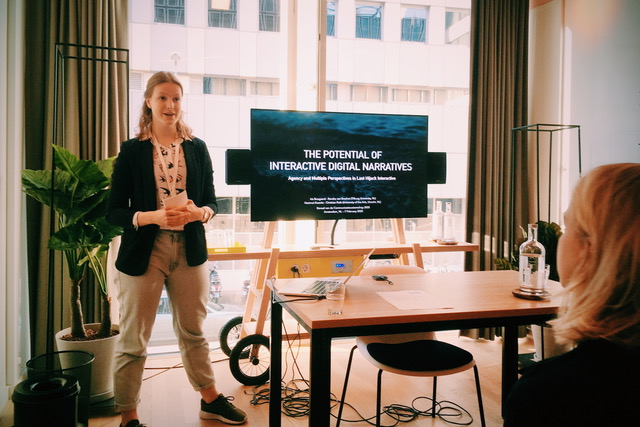 Let me introduce myself, my name is Iris Boogaard and I am a 25-year-old freelance videographer and editor. However, I am also a recent master’s degree graduate in New Media Design. This February, I had the opportunity to present my thesis at the “Etmaal van de Communicatiewetenschapâ€, the annual conference for all communication science scholars in the Netherlands and Flanders.
My thesis focused on interactive narratives, an expressive form of new media in which audience members are allowed to influence important aspects of the story. For instance, they can allow users to engage in multiple perspectives in a narrative. In contrast to traditional narratives, interactive digital narratives (IDN) present information in a non-linear way, as shown in the figure below.

IDN have emerged as promising means for providing new ways to engage us, in fields such as journalism, education and entertainment. However, when looking into previous studies, I soon realized that little empirical research had been carried out investigating whether interactive narratives have the ability to represent complex information. Is information presented in an interactive narrative easier to comprehend than information presented in a traditional linear narratives?
 I explored this question by looking into the award-winning documentary Last Hijack Interactive. This online experience focuses on the Somali piracy crisis, in particular the hijacking of a cargo ship in the Arabian Sea that occurred in 2008. Interestingly, both the actual captain and the hijacker are interviewed to share their perspectives. For each chapter in the story, users of the online interface can decide which side of the story they want to hear.
By creating different versions of this documentary, I was able to study whether having agency and being able to witness multiple perspectives of a narrative can influence one’s understanding of a complex situation such as the Somali piracy crisis. After reviewing over 90 responses in my experiment, I found that participants who experienced multiple perspectives, scored significantly higher on their understanding of the situation. By looking into my qualitative results, I discovered that from a single perspective viewpoint, the hijacker was perceived as a flat character lacking character growth. Since participants weren’t able to create an extensive character model about the hijacker, their understanding scores were lower than participants who experienced the captain’s side or both sides to the story.
What do we learn from this? In order to demonstrate the complexity of a situation, both researchers as well as creators need to keep in mind that rich characters are required from multiple sides of the situation. Moreover, we might need to script interactors by providing both control as well as guidelines on how to interact with a non-linear narratives.
Curious to know how I studied this? I created a short explainer video with a short summary of our research, including explanation of how each variable was manipulated and the results of the study.
With the help of my teachers, we created a short paper about this research, which was accepted to both ICIDS 2019 as well as Etmaal 2020. Earlier this year, I was allowed to present my study at Etmaal. An exciting experience for me, very lovely to be complimented on my work by so many professionals!
Thanks to the help of my teachers for all their support and advice: Renske van Enschot from Tilburg University, and Hartmut Koenitz and Christian Roth from the University of the Arts Utrecht.
Click here to read the conference paper ‘The Potential of Interactive Digital Narratives. Agency and Multiple Perspectives in Last Hijack Interactive’.
Iris Boogaard